
You’re creating content, but it feels like you’re shouting into an empty room. You post on your blog, update social media, and send out newsletters, but nothing seems to stick. This feeling is frustrating and a huge waste of your time and resources. This is where professional content strategy consulting help.
Content strategy consulting can completely change your direction, giving you a clear path forward. If you feel lost in a sea of content ideas with no real plan, understanding what a consultant does is your first step out.
What is Content Strategy Consulting?
You’ve likely heard the term, but what does it really mean? Think of a content strategy consultant as an architect for your online presence. They don’t just help you write a blog post; they design the entire blueprint for what you should create, why you should create it, and who it’s for. When designing your blog posts, they also look at it from not just a traditional structural standpoint but also an SEO standpoint, as shown below:
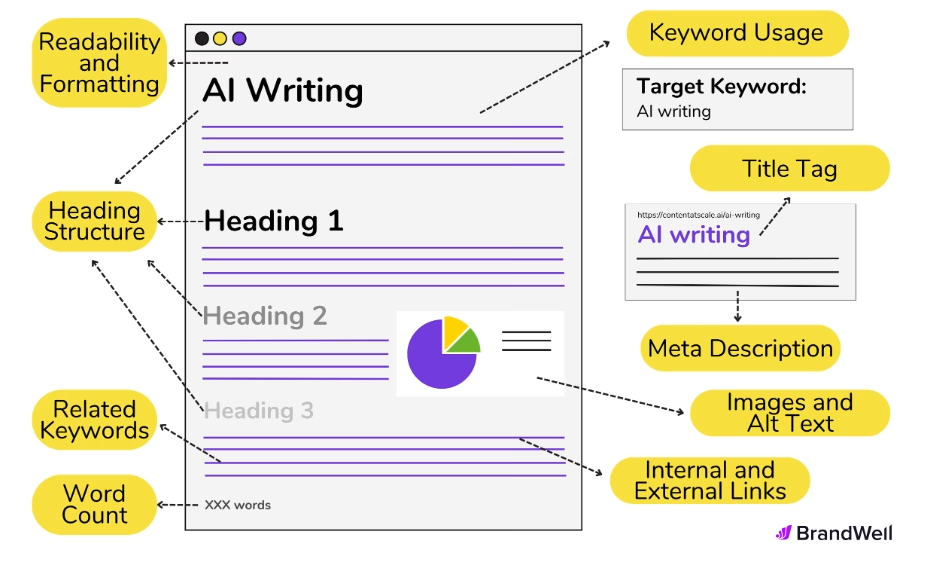
(Source – Brandwell)
Their work is about building a sustainable system for attracting and engaging your audience. Building a sustainable system involves developing a framework for content governance to ensure consistency and brand alignment across all content. A consultant’s goal is to turn your content from a random activity into a reliable business asset.
The consultant’s goal differs from a content marketer, who focuses on executing day-to-day tasks. A consultant examines the broader picture, analyzing your business goals and the competitive landscape. The final result isn’t just a pile of content, but a focused plan that aligns every article, video, and social media post with a specific business objective.
Signs You Might Need Some Help
Are you wondering if it’s time to bring someone in? It’s not always obvious, but certain frustrations are big red flags. If you’re creating content without a clear idea of who you’re talking to, that’s a problem a consultant can solve.
A consultant helps you define and understand your target audience on a deeper level. Here are a few common scenarios where a strategist becomes incredibly valuable:
- Your website traffic has been flat for months, no matter how much you publish.
- You’re getting traffic, but those visitors never turn into leads or customers, which hurts your content marketing ROI.
- Your team members all have different ideas about what your brand’s voice should sound like.
- You feel completely disorganized, creating content on the fly without any long-term plan or editorial calendar.
- You have no idea if your content is actually working because you aren’t tracking the right performance metrics.
If any of these sound familiar, it’s a good sign that your efforts lack a strategic foundation. A consultant can step in to build that foundation with you or, in other cases, for you. They provide the structure needed to make your content efforts predictable and profitable.
The Day-to-Day of a Content Strategy Consultant
A consultant does a lot more than just offer advice. They get their hands dirty with research and analysis to build a plan that works specifically for your brand. Their work revolves around a few core activities that build on each other to create a powerful content engine.
Conducting a Full Content Audit
Before you can plan for the future, you have to understand the past. A consultant’s first big task is usually a content audit. A consultant reviews all of your existing content, including blog posts, web pages, videos, and case studies, to evaluate what’s working and what isn’t.
They look at traffic, engagement, and how well each piece ranks on Google. This process helps identify hidden gems that can be updated and repurposed, as well as dead weight that might be worth deleting. Performing regular content audits can be a huge driver of organic traffic. According to a Semrush report, one-third of marketers conduct content audits at least twice a year.

(Source – Semrush)
The audit also includes a content gap analysis. A content gap analysis identifies topics that your competitors rank for, but you don’t cover at all. It provides a clear list of opportunities to capture more market share and better serve your audience.
To streamline the process and make the content audit easier, a content consultant may utilize content audit tools such as Google Analytics and Screaming Frog.
Collaborating with Cross-Functional Teams
Content strategy consults perform other key tasks that are not previously outlined. They work with different teams across various departments, including:
- Marketing
- Sales
- Product
- Technology and Design
They collaborate with other departments to understand their roles and content, aligning content initiatives with business goals. Collaborating with SMEs and leveraging their expertise will help ensure brand consistency across all types of content, regardless of its origin.
Conducting Content Strategy Sessions
Interviewing key stakeholders including executives help gain a better understanding of the business objectives and goals. Content strategy consultants also meet internal teams to gather content requirements, identify pain points, and align on strategic priorities.
Getting to Know Your Audience
You can’t create effective content if you don’t know who you’re making it for. This seems simple, but many businesses have only a vague idea of their ideal customer. A consultant helps you move past assumptions and into data-backed insights through deep audience analysis.
They will develop detailed buyer personas, which are representations of your ideal customers. These personas are compiled from data gathered through market research, surveys, and your existing customer information. They inform every piece of content you create, from the topics you choose to the tone you use.

The consultant then performs customer journey mapping. This process outlines the stages a person goes through, from first hearing about your brand to becoming a loyal customer. Creating content for each stage of this journey makes your marketing more effective and helpful.
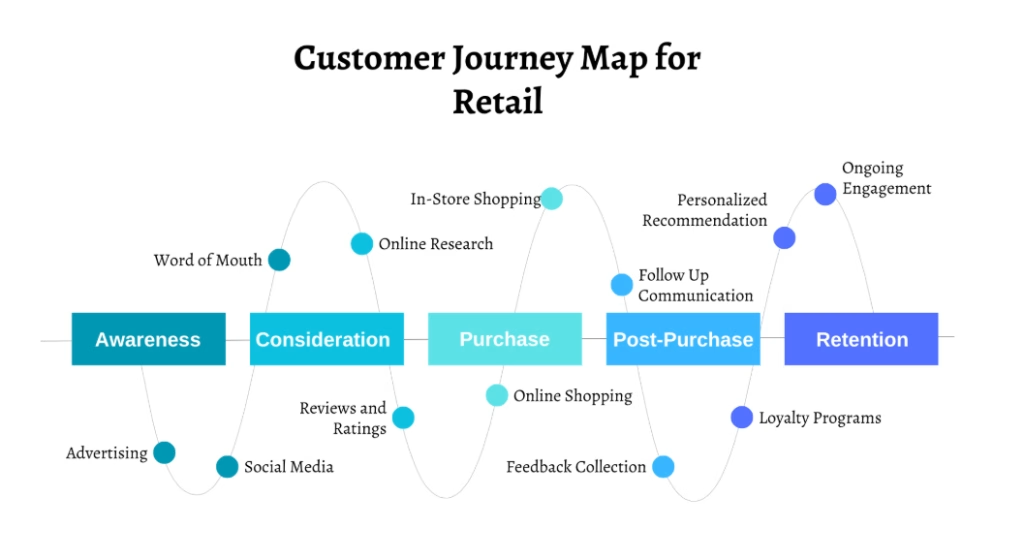
(Source – Zonka)
Defining Your Brand’s Core Message
What makes your business different from the competition? A content strategy consultant helps you answer this question with absolute clarity. They work with you to sharpen your brand messaging and establish a consistent brand voice and tone, which is vital for building trust and recognition. For example, to improve your brand messaging, ask yourself the following:
- What problem do we solve that no one else solves quite the same way?
- Who is our ideal customer, and what specific pain points do we address for them?
- What core values drive our business decisions and customer interactions?
- What is our brand’s personality, and how should it be conveyed across all touchpoints?
- What proof points and success stories demonstrate our expertise and credibility?
Your brand’s message is the foundation for all your brand storytelling. It’s the core idea you want people to associate with your company. Whether a customer is reading a tweet, a blog post, or an email, the experience should feel consistent.
The consultant will also create a style guide that your entire team can use to establish your company as a thought leadership source. For example, organizations such as Gartner and 3M are regarded as thought leaders within their respective industries. Gartner focuses on research and advisory services, while 3M focuses on applied sciences and solving complex global issues. This document makes sure that everyone creating content is on the same page.
Building a Practical Content Plan
Ideas are great, but execution is what matters. A strategist translates the high-level plan into an editorial calendar. This is your roadmap for what to publish, where to publish it, and when to publish it. It removes the daily guesswork of what to post today.

A modern SEO content strategy often uses a topic cluster model. This involves creating a main pillar content page on a broad topic and linking out to several related, more specific cluster pages. This structure shows search engines that you have authority on a subject.
Here is a simple example of how that might look:
| Pillar Content (Broad Topic) | Topic Clusters (Specific Subtopics) |
|---|---|
| The Ultimate Guide to Digital Marketing | 1. What is SEO? Beginner’s Guide to Social Media Ads 2. How to Start Email Marketing- Understanding PPC Campaigns |
| A Complete Overview of Project Management | 1. Best Project Management Software- Agile vs. Waterfall Methodologies 2. How to Improve Team Communication- Setting Realistic Project Timelines |
The consultant also establishes a content creation workflow. The content creation workflow process outlines every step from ideation to publication and promotion. Key areas within the workflow include:
- Planning & Outlining – Includes creating content briefs, developing detailed outlines, and establishing publication schedules.
- Content Writing & Development – The process includes crafting the actual content and incorporating SEO best practices.
- Editing & Review – Includes proofreading for grammar and clarity, as well as fact-checking of information.
- Publishing & Formatting – Uploading content to the platform, formatting for web or print, adding meta descriptions, tags, and optimized images.
- Promotion & Distribution – Sharing content across social media channels and sending to email lists.
A content creation workflow also clarifies roles and responsibilities, making your content production much more efficient.
Finally, the calendar includes a content distribution strategy. Creating great content is only half the battle; you also have to get it in front of the right people. This plan outlines how you’ll promote your content through channels like email marketing, social media (i.e., LinkedIn, Bluesky Social, and X (Twitter)), and outreach.
Measuring What Matters
How do you know if your content strategy is working? A consultant sets up a framework for measuring success. They help you identify the key performance metrics that truly matter for your business goals, like the following:
- Organic traffic
- Lead generation
- Conversion rates
- Bounce rate
- Session Duration
- Returning Visitor Rate
- Page Views Per Session
They won’t just hand you a report full of confusing numbers. Instead, they’ll help you understand what the data means and how to use it to make better decisions. Tracking the right metrics is fundamental to proving the value of your content and refining your approach over time. According to Marketing Exec, tracking the right metrics also ensures that your team is aligned and that you’re making data-driven decisions that propel your business forward.
This focus on data creates a cycle of continuous improvement where your strategy gets smarter. You’ll know exactly what’s driving results and where to invest your resources for the best content strategy ROI. This transforms content from an expense into a measurable growth driver for your business.
How Do You Find the Right Consultant?
Finding the right partner for your content strategy consulting needs is crucial. A good consultant should feel like an extension of your team. You can start your search on professional networks like LinkedIn or look through respected freelance marketplaces like Freelancer. If you don’t want to go with a freelance consultant, a quick Google search will also provide a list of consulting companies that can also help you.
When speaking with potential candidates, don’t just review their resumes. Look for the following:
- Portfolio of prior work
- Industry knowledge
- Communication style
- Writing process
You want to see that they’ve successfully solved problems similar to yours for other businesses. It’s important to see proof of their abilities and past successes. Here are a couple of potential questions to ask:
- What is the potential hire’s writing process?
- How do you ensure everyone within a cross-functional team stays aligned and that the content supports broader business objectives?
- How would you prioritize content initiatives for a client who can only produce 2-3 pieces of content per month?
- How do you balance creating content that serves SEO and search visibility goals while still maintaining an authentic brand voice and providing genuine value to the audience?
- Can you share a specific example of a content strategy you created that didn’t perform as expected?
A good strategist will be able to clearly explain how they approach a new project from start to finish. Ask how they conduct audience research or what tools they use for a content audit.
Finally, check for chemistry. This will be a close partnership, so you need to find someone with whom you communicate well and trust. A great consultant doesn’t just give you a plan; they empower you and your team to execute it effectively for years to come.
What to Look for in a Content Strategy Consultant
When you are looking for a content strategy consultant, there are many things to think about. It’s great to have their resumes, as well as a portfolio of their prior work experience, but it’s also important to consider other key determining factors. For example, think about the following:
Salary and Rate
When considering hiring a content strategy consultant, their rates are crucial. Suppose the rate is too high; then it’s wise to move on. If it’s too low, you may wonder why. You want to make sure whoever you choose is within your budget.
If you’re looking to onboard someone full-time with a salary and benefits, you have more control over that situation. It’s wise to ensure that you set the salary at a level that makes you comfortable. According to Salary.com as of October 2025, the average annual salary for a content strategist in the United States is $73,589. The $73,589 breaks down to an hourly rate of $ 35.50, and the semi-monthly rate is $3,066.

(Source – Salary.com)
Prior Customer Feedback and Rating
While it’s great to review their portfolio of prior work, it’s also beneficial to examine prior customer feedback. Review the ratings and customer feedback or testimonials to gauge how the potential candidate has worked with others. Did they satisfy their previous customers’ goals and objectives? Many freelance websites, like Upwork, provide prospective hiring companies with the opportunity to review ratings of their potential hires. LinkedIn is a great website for finding salaried and contractors.
Work Model Preference
Depending on your organization’s structure, you may need your team to work in the office. If your potential hire is not in your location and only works remotely, that may be a deal breaker. Before hiring someone, ensure they align with your work model preferences. There are three work model preference choices to choose from:
- In-person – Requires the individual to work in person or within an office with their co-workers.
- Remote – The remote option allows the person to work from a remote location. They meet and interact with their team virtually.
- Hybrid – The hybrid option combines in-person and online elements. For example, most organizations follow the 3-2 model, where a person goes into the office 3 days a week (Monday, Wednesday, and Friday). On Tuesdays and Thursdays, the person can work remotely.
I love the hybrid model as it provides the best of both worlds and gives the right amount of flexibility for the team.
Conclusion
Trying to grow your business with content but without a clear plan is like trying to build a house without a blueprint. You might put up a few walls, but the structure won’t be stable or effective in the long run. Professional content strategy consulting provides that blueprint.
A strategist connects your content directly to your business goals and clarifies your brand message. They help you understand your audience on a deeper level and establish a system for consistently producing high-quality content.
By implementing a solid plan, you can turn your content from a source of frustration into your most powerful tool for growth. If you’re tired of guessing and want to see real results from your efforts, it might be time to get some expert help.