
You spend a lot of time creating content. You write articles, produce videos, and design infographics. But do you know if any of it is actually working? This is a common problem for marketers and writers who need a way to determine how to measure content ROI.
Proving the value of your work can feel impossible. You see traffic increase, but you can’t directly connect it to sales. Learning how to measure content ROI shows you exactly what works, so you can refine your marketing strategy and get better results.
You spend a lot of time creating content. You write articles, produce videos, and design infographics. But do you know if any of it is actually working? This is a common problem for marketers and writers who need a way to determine how to measure content ROI.
Proving the value of your work can feel impossible. You see traffic increase, but you can’t directly connect it to sales. Learning how to measure content ROI shows you exactly what works, so you can refine your marketing strategy and get better results.
What Is Content ROI?
Content Return on Investment (ROI) is a performance metric that measures the revenue generated by your content marketing efforts against the expenses incurred. It is a straightforward way to tell if your content marketing efforts are profitable. A positive ROI indicates that your content marketing strategy is effective, while a negative one suggests a need for adjustment.
The basic content marketing ROI formula is (Return on Investment) / Investment. To express it as a percentage, multiply the result by 100. For instance, if you get a positive number, you’re making money; a negative one means you’re losing it.
While the ROI formula itself is simple, the challenge is accurately identifying what counts as a return and what to include in your total investment cost. The financial impact of your content isn’t always immediate sales, which makes careful tracking essential for getting an accurate picture of its effectiveness.
Content ROI is something that many people overlook, they dismiss it as being unimportant. Unfortunately for me, content ROI was something I ignored for the first six to seven months of my blog.
I focused on creating content in line with my content strategy. This is mainly because I am a solopreneur with limited time to focus on all the facets of running a website. Don’t make the same mistake. It’s vital to focus on both content development and measuring your content’s ROI which is something I now do.
The Tools You’ll Need
Before you can measure anything, you need the right tools in your marketing operations. Many of these platforms offer free versions that are powerful enough to get you started. They help you gather the data needed for your marketing ROI formula calculations.
First, you must have Google Analytics. It tracks website traffic, user behavior, and conversions, which is essential for any marketing campaign. You can see which blog posts are driving traffic and which ones lead to actions, such as newsletter signups or generating qualified leads.
You should also utilize a Customer Relationship Management (CRM) platform, such as HubSpot or Salesforce. A CRM helps you track leads from the moment they discover your specific content. Additional key tasks CRM’s help you with are the following:
- Centralizes Customer Data
- Tracks Sales Pipeline and Opportunities
- Automates Communication and Follow-ups
- Generates Reports and Analytics
- Facilities Team Collaboration
It shows you the entire journey from a reader to a paying customer, linking revenue back to your content efforts.

(Source – HubSpot)
Having an SEO tool is also important. It is invaluable for measuring content performance. These tools also perform the following:
- Keyword Research and Analysis
- Backlink Monitoring and Analysis
- Site Audit and Technical SEO Analysis
- Rank Tracking and SERP Monitoring
- Content Optimization Recommendations
Tools such as Ahrefs, SEOptimer, or Moz can show you keyword rankings, backlink profiles, and estimate the value of your organic traffic. This helps you assign a real dollar amount to the traffic your content generates, which you would otherwise have to pay for with paid ads.
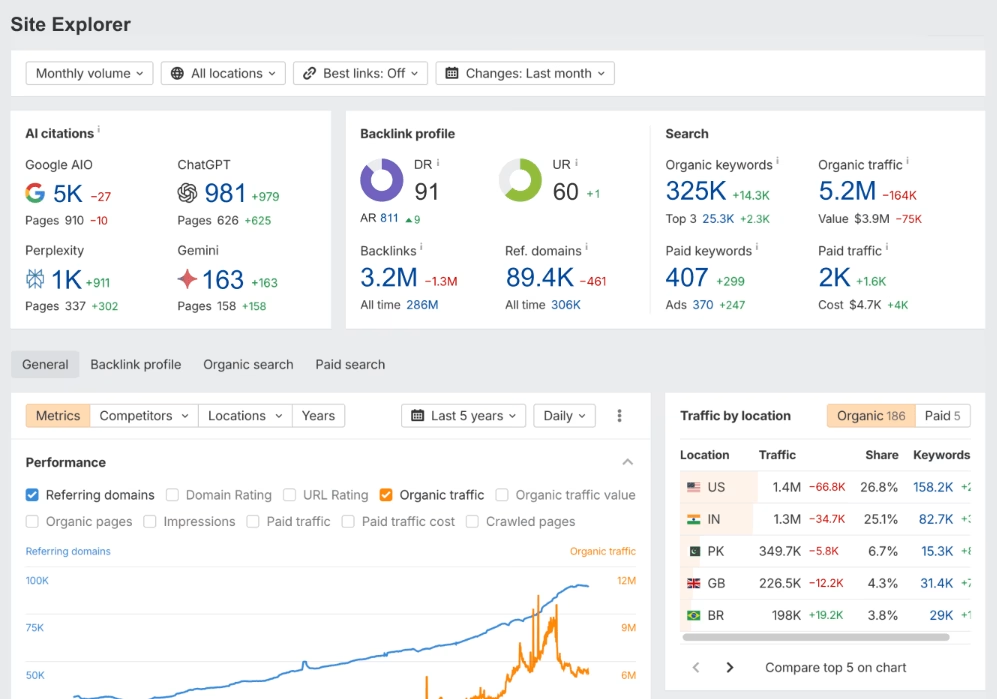
(Source – Ahrefs)
A Simple Framework for How to Measure Content ROI
Getting a precise number for your marketing ROI takes organization. You need a clear process to accurately track your total cost and returns. This framework breaks down how to measure content marketing ROI into four manageable steps.
Step 1: Calculate Your Content Investment
Your total investment is more than what you pay a writer. It includes all costs tied to producing and promoting a piece of content. You need to account for everything to get an accurate number for your content marketing ROI calculation.
Start with the direct costs of creation. This could be freelancer fees, the cost of stock photos, video marketing production, or editing expenses. Your total cost should reflect every dollar spent on creating the user-generated content itself.
Next, add the cost of tools and overhead. If you use scheduling tools, SEO software, or content management systems, a portion of the subscription cost is allocated to each content piece. Also, factor in the time your marketing teams spend on the content marketing operations, from ideation to publication.
Last, include your promotion and distribution costs. This covers the money spent on social media posts, paid ads, or influencer marketing to get your content seen by your target audience. Summing all these figures gives you the total investment cost for your content.
Step 2: Identify Your Key Performance Indicators (KPIs)
Your return is not always about direct sales. The value of content depends on its goal within your overall marketing plan. You must match your metrics to your specific marketing goals to measure content marketing success effectively.
If your goal is brand awareness, look at traffic, social shares, and brand mentions. These metrics indicate the number of people who are seeing your brand and how your content is resonating with them. Other key content-based KPIs include:
- Engagement Rate – Measures how users interact with your content through likes, comments, and shares.
- Conversion Rate – Percentage of content visitors who complete desired actions like newsletter signups and demo requests.
- Bounce Rate – Percentage of visitors who leave after viewing only one page.
- Lead Quality Score – Metrics include lead-to-customer conversion rate, average deal size, and sales cycle length to determine content’s impact on revenue.
For lead generation, your primary KPIs are different. You should track metrics like email signups, form completions from your case study, and content downloads to see how many leads generated came from your content. These actions turn an anonymous visitor into a known lead that your sales teams can follow up with.
When the goal is sales, the metrics are much clearer. You track conversions attributed to your content, the revenue you’ve generated from specific articles, and the overall customer acquisition cost. These directly tie specific content to money in the bank.
Step 3: Track and Attribute Your Returns
Attribution is often the most difficult part of calculating ROI for content marketing. It involves connecting a specific action, such as a purchase, back to the impact that content marketing had on that decision. Using your tools correctly makes this process much more manageable across different marketing channels.
You can use UTM parameters in your links to improve performance tracking. These are simple tags added to a URL to track the origin of traffic. For example, you can see how many people clicked a link in your email newsletters versus a link from one of your media posts.
There are five standard UTM parameters. For reference, the UTM parameters are listed below:
- UTM_Campaign – Name the campaign (e.g., Winter Closeout Sale).
- UTM_Content – Differentiates similar content or links within the same advertisement.
- UTM_Medium – Specifies the medium (Examples – Email and CPC).
- UTM_Source – Identifies the source of traffic (Examples – Google, Bing, and newsletter).
- UTM_Term: Used for paid search to identify keywords.
Setting up goals in Google Analytics is also essential. A goal could be a completed purchase or a submitted contact form, providing data on conversions. Analytics can show you which pages visitors viewed right before they achieved a goal, helping you measure content performance.
Your CRM helps tie everything together into an accurate picture. It might show that a customer read three of your blog posts and downloaded a whitepaper before asking for a demo. This allows you to give your content partial credit for the sale through a process known as marketing attribution modeling.
Step 4: Calculate the Final ROI
Now you have your two main numbers: your total investment and your return. You can plug them into the ROI formula to see how your content performed. This calculation is straightforward and can be performed using a simple ROI calculator spreadsheet.
Imagine you spent $500 on a blog post. The $500 expense includes writing fees, images, and a small ad spend. That $500 is your investment cost.
From that blog post, you generated 10 new qualified leads, and two of them became customers. Each customer paid $1,000, so your total revenue generated is $2,000. Now you can use the content marketing ROI formula to do the math.
The formula subtracts the total investment from the return. The calculation is ($2,000 – $500) / $500. The equation equals 3; multiplying by 100 gives you a 300% marketing ROI. For every dollar you invested, you got three dollars back.
| Item | Amount |
|---|---|
| Content Investment | $500 |
| Generated Revenue (Return) | $2,000 |
| Profit (Return – Investment) | $1,500 |
| Final ROI (Profit/Investment) X 100 | 300% |
A high-level view of the final content strategy ROI is as follows:

Metrics That Matter for Content ROI
Examining specific metrics more closely provides a clearer view of your content’s value. Not every return is a direct sale, but these other metrics still contribute to your business goals. They show how your basic content marketing efforts build momentum over time.
Website Traffic and Engagement
More website traffic means more potential customers. You should closely monitor your organic search traffic as a primary indicator of success. A high-ranking blog post can be a consistent source of driving free and relevant traffic for years to come.
Engagement metrics also play a significant role. Metrics like time on page and pages per session show if people are actually reading your content and finding it valuable. Higher engagement can also signal content quality to search engines, boosting your rankings.
You want visitors to stay and engage with what you’ve created. If people leave your site immediately after arriving, that high traffic number is much less valuable. Different content types, such as engaging video content, can help improve these metrics.
Lead Generation and Conversion Rates
Traffic is significant, but leads are better for business growth. A lead is someone who has shown interest in what you offer, such as by providing their contact information.
Track how many visitors from a blog post fill out a contact form or subscribe to your email list. The conversion rate is calculated by dividing the number of leads generated by the total number of visitors to that page. A higher conversion rate means your targeted content is resonating with your buyer personas and is persuasive.
Buyer personas establish a direct connection between fundamental content and business expansion. Each new lead is a valuable opportunity for a future sale. Improving these rates is one of the most effective content marketing tactics. Here is an example of a buyer persona chart.

SEO Performance
Your content’s performance in search engines has a clear, tangible value. A strong SEO strategy attracts qualified visitors who are actively searching for solutions that your business provides. Great content, like a well-researched case study, can also attract backlinks from other websites.
Backlinks act like votes of confidence from other sites. Moz explains that they are a strong signal to search engines that your content is authoritative and trustworthy. Authoritative and trustworthy content helps your content rank higher for important keywords relevant to your target audiences.

(Source – Moz)
Some SEO tools can even assign a dollar value to your organic traffic. They estimate what you would have to pay for the same amount of traffic through paid ads. This calculation shows a direct cost saving, which is a powerful form of return on your ROI content.
Customer Acquisition Cost (CAC)
Customer Acquisition Cost (CAC) refers to the average amount spent to acquire a new customer. Content marketing is often more cost-effective than other marketing tactics, such as paid advertising. The cost-effectiveness means it can lower your overall CAC and improve profitability.
If your average CAC from paid ads is $200 but only $50 from your content marketing efforts, you are saving $150 per customer. These savings are a real return on your investment. It helps make your entire business more financially stable and scalable.

By showing how content lowers business costs, you prove its value beyond the revenue you’ve generated directly. This data is critical for justifying your marketing budget and helps you make informed decisions about resource allocation.
Customer Retention Rates (CRR)
Customer retention rates measure the effectiveness of your content in supporting existing customers. Your content can support your customers in various ways, including but not limited to the following:
- Educational resources
- Usage guides
- Whitepapers
- Instructional Videos
Successfully supporting your customers increases the probability of retaining them. Customer retention will also help convince customers to purchase more products and services.

Customer Lifetime Value Impact (CLV)
Repeat purchases are vital to the success of your business. Your content strategy influences your ability to build a strong customer base. Strong content will help educate customers about your various products and provide more value. Adding value to your content strengthens relationships and can significantly increase the lifetime value of your customers.
CLV is calculated as follows:

Customer Lifetime Value Impact (CLV)
Repeat purchases are vital to the success of your business. Your content strategy influences your ability to build a strong customer base. Strong content will help educate customers about your various products and provide more value. Adding value to your content strengthens relationships and can significantly increase the lifetime value of your customers.
CLV is calculated as follows:

Conclusion
Understanding how to measure content ROI is a fundamental skill for any serious marketer. It transforms your content from a creative expense into a predictable business driver with a measurable financial impact. The process requires setting up your tools correctly, tracking your investments thoroughly, and properly attributing your returns.
Start with a simple framework for calculating your total cost and tracking key metrics related to your marketing goals. Over time, you can adopt more sophisticated attribution models to get an even more accurate picture. Knowing your numbers helps you make smarter decisions, refine your content marketing strategy, and prove the value of your hard work to stakeholders.