
Content Strategy vs Content Marketing: Key Differences Explained (2025 Guide)
Written by David L Hicks – January 18th, 2025
Content strategy and content marketing are vital disciplines to an organization’s success. Oddly, many people use these terms interchangeably. There is a difference between content strategy and content marketing, in fact there are many. Many people don’t understand that these two disciplines, although different in principles and purpose, do rely on each other. In many ways, content strategy and content marketing go hand in hand.
This blog article will define content strategy and content marketing and their primary benefits. In addition to their definitions and benefits, we will walk you through their key differences and what you can do to implement and use them successfully.
What is Content Strategy?
A content strategy is a comprehensive framework that guides the creation, development, delivery, and management of your organization’s content. Building a content strategy requires a great deal of time and effort.
At a high level of content strategy typically involves:
- Defining your content’s purpose and audience
- Creating governance frameworks
- Establishing content standards and guidelines
- Planning content lifecycle management
- Developing metadata and taxonomy structures
Essentially, think of a content strategy as being a building architect. You need detailed blueprints before you start laying bricks or choosing paint colors. Earlier in my career, I was asked to create a couple of information security blog articles for my firm.
When we were asked to create articles and post them on the company’s website, management expected leads and customers to swarm in. They didn’t, and that’s because there was no content strategy plan or research behind it.
Benefits of Having a Content Strategy
A content strategy has many benefits. Below is a brief list of the key benefits.
Improve Content Governance
The importance of having a structured governance framework around your content strategy grants you clear guidelines and processes that help reduce content inconsistencies. Reducing your content inconsistencies improves the quality of your data across your content. Quality is paramount for improving your chances of reader and customer growth.
Long-term Scalability
The ability to scale your content, whether up or down, is a key dimension in your content strategy arsenal. Without it, you cannot pivot to your organization’s needs. Correctly forecasting when you can scale up or down assists content strategists with building a proper content plan and content calendar.
Optimizing Your Resources
Strategic planning helps organizations allocate resources more effectively by identifying priorities and eliminating any redundancies or unnecessary (unneeded) content.
Better User Experience
Content strategy ensures content is organized, findable, and relevant to user needs, leading to improved engagement and satisfaction.
Content Strategy Key Components
A content strategy is an extensive framework with many key components that make it run.
At its core, content strategy encompasses:
- Content governance and ownership
- Creation and maintenance workflows
- Quality standards and guidelines
- Content lifecycle management
- Information Architecture
- Content modeling and structured content approaches
Content Strategy Management
Several key components must run smoothly to ensure the content workflow process is appropriately developed.
You are part architect, part librarian, and part traffic controller. You’re responsible for:
- Developing content models that scale
- Creating taxonomies and metadata frameworks
- Establishing style guides and tone of voice documents
- Managing content teams and workflows
- Aligning content initiatives with business goals
These are not responsibilities to be taken lightly. If one cog in that machine breaks, the rest will follow.
Content Strategy Alignment with Business Objectives
The security blog initiative from my prior employer ultimately fell short for another critical reason beyond previously discussed: our content failed to align with our core business objectives. Content strategy alignment with your business objectives is a must-have.
Your content strategy must also align with your customers’ needs. Before creating a good content strategy, you must document your business objectives and understand your customers’ needs.
What is Content Marketing?
Content marketing creates and distributes valuable content to attract and retain a clearly defined audience. I find content marketing interesting because it is both an art and a science. The art involves building materials such as written articles/blog posts, videos, newsletters, etc. The science consists of analyzing the metrics behind what content is successful and what isn’t. When the art and science of it are in sync, you’ll see success.
Primary Goals of Content Marketing
Content marketing has many primary goals. If all of those goals are accomplished, you are guaranteed to have a successful campaign. The primary goals typically include the following:
- Building brand awareness and authority
- Generating qualified leads
- Nurturing customer relationships
- Driving conversions and sales
- Improving customer retention
Benefits of Content Marketing
Content marketing, like content strategy, has many benefits when leveraged correctly. Leveraging content marketing can provide the following benefits below.
Increased Brand Awareness
Effective content marketing helps organizations reach new audiences and build recognition through valuable, shareable content.
Lead Generation
Organizations can attract and convert qualified leads interested in their products or services by creating targeted, valuable content.
Customer Retention
Regular, helpful content keeps existing customers engaged and informed, increasing loyalty and lifetime value.
Cost-Effective Promotion
Content marketing often provides better long-term ROI through organic traffic and continued engagement than traditional paid advertising.
Types of Content Marketing Initiatives and Campaigns to Leverage
What’s great about content marketing is that you can achieve success with many different approaches. There isn’t just one way to market your content successfully. Below are some methods that are popular among marketers and content developers.
Awareness Campaigns
An awareness campaign in content marketing is a strategic initiative used to educate your target audience about your organization’s brand, products, services, or customers’ issues.
As a content marketer, you can leverage multiple forms of content materials. Among the content materials used for your awareness campaigns include the following:
- Blog posts/articles
- Emails
- Videos
- Social media (Bluesky Social, Pinterest, Facebook, Twitter (X), and Instagram)
With the successful implementation of this campaign, you’ll achieve your primary goal of increasing visibility and understanding.
Lead Generation Campaigns
A Lead generation campaign in a content marketing campaign is a targeted effort that creates and distributes valuable content designed to capture potential customers’ contact information. Lead generation campaigns reach potential customers in many ways, including online forms, landing pages, and email.
The campaign offers valuable content like whitepapers, webinars, or exclusive content in exchange for prospects’ information. Performing this campaign allows businesses to build a database of qualified leads for future marketing and sales efforts.
Customer Education Content Development
This type of content helps existing customers get more value from your products or services. It is similar to an awareness campaign in that it educates customers. The content also aims to improve customer success, reduce support queries, and build customer confidence to use the product or service effectively.
Common types of customer education content include:
- Comprehensive Product Tutorials and How-to Guides – Walks users through specific features and functionalities step by step.
- Video Demonstrations and Webinars – Provides visual instruction and real-time learning opportunities.
- Knowledge Base Articles and FAQs – Address common questions and troubleshooting issues.
- Case studies and best practices documentation – Showcase successful implementation examples and optimal usage strategies.
Content Marketing Distribution and Promotion
The most critical role content marketing plays is distribution and promotion. Distribution and promotion push your content through various channels to improve its visibility. Without a distribution plan, your content’s audience won’t grow, no matter how good it is.
Common Content Marketing Channels and Formats
Marketers can leverage many content marketing channels to ensure their success. It’s important to know, however, that different channels serve different purposes, and I recommend choosing them based on specific objectives:
Written content
- Blog posts and articles
- Whitepapers and ebooks
- Case studies
- Email newsletters
- Website copy
Visual content
- Infographics
- Videos and webinars
- Graphics for social media
- Presentations
It’s important to note that content marketing is about providing real value to your audience while accomplishing your business objectives and goals.
Core Differences Between Content Strategy and Content Marketing
Now that we have walked through content strategy and marketing, we can review their differences.
Strategic Planning vs Tactical Execution
Two primary items come to mind when looking at the differences strategic planning and execution.
The discipline of content strategy acts as the starting point of your content development journey. It involves establishing your content’s vision and goals. Your content strategy will eventually guide your content marketing approach. Your content strategic planning must take into account your organization’s business objectives. Content strategy plays the long game, which allows content marketing, with its tactical execution, to play the short game.
Content marketing focuses on tactically implementing these strategic directives through specific content creation, distribution, and promotion activities. While content strategy answers the “why” and “what” of content decisions at an organizational level, content marketing handles the “how” and “when” of actual content execution and delivery to target audiences.
Long-Term Vision vs Campaign-Based Approach
Content strategy is a comprehensive, long-term framework that aligns content initiatives with broader business objectives. It also establishes guidelines, workflows, and governance structures that guide content decisions for years to come.
While guided by content strategy, content marketing typically focuses on executing specific campaigns with defined timelines, metrics, and immediate goals, such as lead generation or brand awareness.
Your content strategy asks, “How does our content support our organization’s mission over the next several years?” Content marketing asks, “How can we create and distribute content that achieves specific campaign goals over the next few months?”
Content strategy involves:
- Developing content models and frameworks
- Creating governance policies
- Establishing editorial guidelines
- Planning content lifecycles
- Building sustainable workflows
Content marketing focuses on:
- Creating engaging content pieces
- Managing distribution channels
- Running specific campaigns
- Tracking performance metrics
- Optimizing based on results
Documentation and Governance vs Creation and Distribution
Content strategy primarily focuses on documentation and governance, while content marketing focuses on creation and distribution.
At its core, documentation and governance pertain to establishing and maintaining the rules, guidelines, and processes that ensure content consistency, quality, and compliance across an organization. They also track content performance and maintain content inventories.
Creation and distribution, on the other hand, represent the actual hands-on work of producing content and delivering it to target audiences through various channels, according to content marketers.
Documentation and governance provide the framework and standards that guide content operations, creation, and distribution and execute a content strategy that directly engages with audiences.
Different Skillsets and Team Responsibilities
Strategy and marketing require distinct but complementary skillsets.
Below is a high-level summary of skillsets for each:
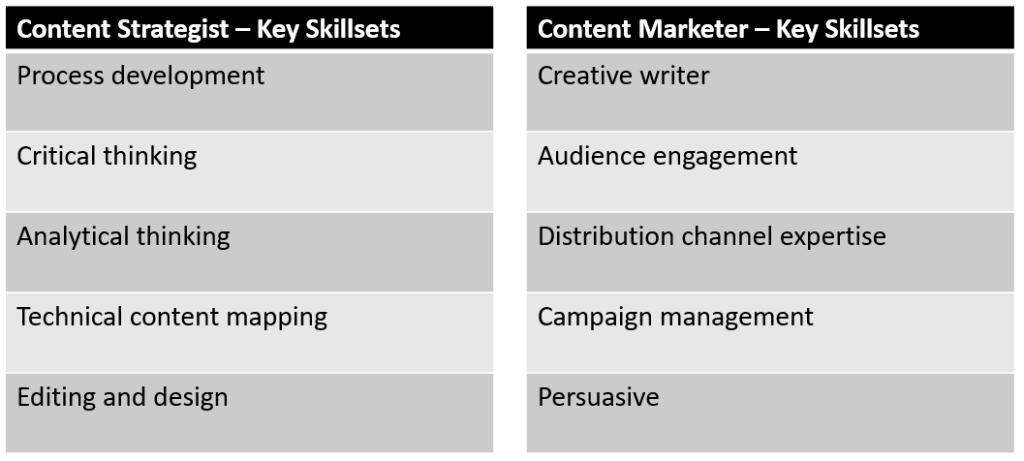
One thing to keep in mind, this was by no means an exhaustive list and is meant to be a high-level summary to capture key skillsets for each role. He more skillsets added for each there will be a higher probability for some overlap.
How Content Strategy Supports Content Marketing
Although these two disciplines are different, they have a symbiotic relationship. Without content, there is nothing to market. If you have content but no way to market it, you’re aimless. From an overall process standpoint, it starts with content strategy.
Once in place, content strategy allows content marketing to take over. Below is a list of key areas where content strategy supports content marketing.
Creating Foundational Content Guidelines
As previously noted, content strategy allows you to establish important guidelines for all content marketing activities. It is a blueprint for your content marketing team to follow and execute.
A strong content strategy provides the following:
- Voice and tone standards
- Content quality criteria standards
- Editorial processes
- Style guides
- Brand messaging frameworks
These foundational guidelines set up by your content strategy ensure content marketing teams can create consistent, high-quality content that resonates with target audiences while maintaining brand integrity across all channels and campaigns.
Ensuring Brand Consistency Across Various Marketing Efforts
When you think of successfully branded companies like Apple and Google, one thing that sets them apart is that they know exactly who they are.
Both organizations have robust content strategies supporting their marketing efforts. I know this may sound repetitious, but your content and marketing efforts must align with your content strategy to be successful.
Strategic Brand Alignment
The content strategy ensures all content marketing initiatives consistently reflect and reinforce the brand’s core values, positioning, and messaging across every touchpoint and campaign.
This strategic alignment assists your content marketing team in creating materials that achieve immediate campaign objectives and strengthen overall brand identity and recognition in the market.
The content strategy ensures marketing efforts remain on-brand by focusing on the following:
- Consistent messaging frameworks
- Visual content guidelines
- The tone of voice documentation
- Channel-specific standards
- Brand story alignment
Integration with Overall Digital Strategy
Content strategy shouldn’t exist on an island. The world is a digital place, for example the number of digital shoppers is expected to grow to 285 million in 2025. You must integrate your digital strategy with both your content strategy and marketing.
Strategic Integration Points
When aligning your content strategies and marketing, you should ensure your strategy connects with the key integration points listed below:
- Overall business objectives
- Digital marketing goals
- Customer experience initiatives
- Technical infrastructure
- Analytics and measurement systems
By maintaining this strategic alignment between your digital strategy, content strategy, and content marketing efforts, you can build stronger connections with your audience and drive meaningful business results.
Common Challenges and Solutions
As previously stated, content strategy and marketing are two different disciplines. Many organizations have issues with trying to align the two. Here are some of the most common hurdles content developers, content marketers’ bloggers, and organizations have faced while trying to use them together.
Aligning Strategy with Marketing Execution
One of the most frustrating things for marketing teams to do is create amazing content that completely ignores their strategic guidelines. The disconnect was causing all kinds of chaos. You can quickly lose messaging and purpose with your existing and potential customers.
To avoid the issue, align your content strategy framework when developing your marketing campaigns. You can do this by performing the following actions:
- Create clear communication channels between strategy and marketing teams
- Implemented regular cross-team meetings
- Established clear KPIs that bridged both disciplines
- Build feedback loops for continuous improvement
- Developed a shared content calendar that linked tactical content to strategic goals
Alignment is paramount to the success of your marketing campaigns.
Building Effective Workflow Processes Between Teams
Without people, your processes and execution of those processes are irrelevant. Some organizations don’t have a team or workflows that keep things moving. You must have the right people to build effective teams and execute processes to align your strategy and marketing. Your workflows must be constructed and executed adequately with your team in place.
There are various workflows you should implement to ensure your team’s success; they include the following:
Creating Process Workflows
- Implemented clear approval processes
- Defined team roles and responsibilities
- Created content templates and checklists
- Established realistic timelines
- Set up collaboration protocols
Another effective solution is creating a RACI chart (Responsible, Accountable, Consulted, Informed) for different content types.
RACI Chart Legend: A RACI chart defines team roles across four primary categories
- Responsible – People who performs the work.
- Accountable – People who approve the work (final say), they are essentially in charge.
- Consulted – People who are consulted and informed on what is going on with the process. They are also sometimes identified as subject matter experts the content is based on.
- Informed – People that need to be kept in the loop in terms of what is going on.
A RACI chart clarifies who does the work, who is in charge, whose opinion matters, and who needs to stay in the loop for each task, milestone, or decision.

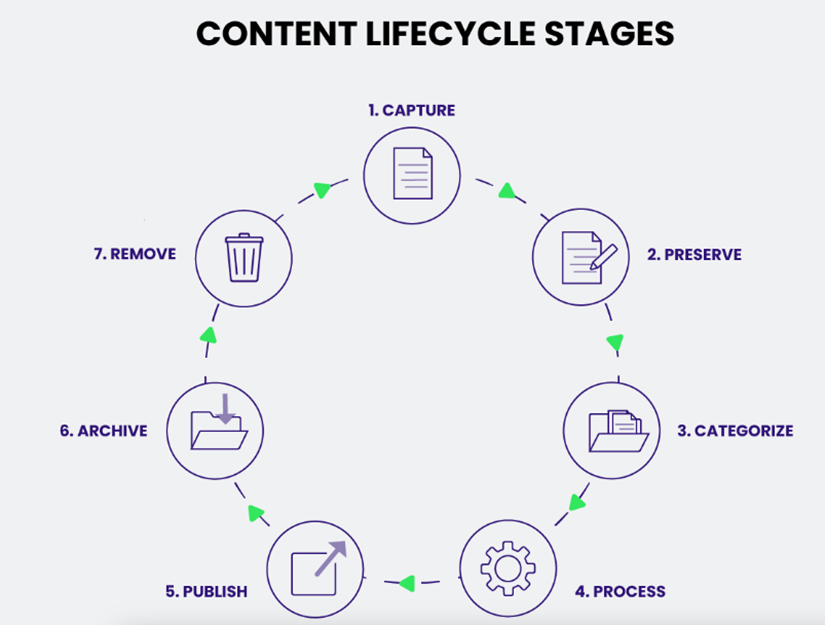
Managing Content Lifecycle and Governance
When organizations mistakenly treat content strategy and marketing as separate entities, this unfortunately leads to fragmented content lifecycles. Fragmented and inconsistent content lifecycles also lead to inconsistent governance practices, preventing effective content.
If your content is impractical, it is guaranteed to have poor content and processes.
To remedy the issue, you must implement a governance and content lifecycle management process. Below is a list of lifecycle solutions that will help you achieve success.
- Implemented content expiration dates
- Created content review schedules
- Developed archive procedures
- Established update protocols
- Built content retirement workflows
(Source – Keyshot)
Implementing Both in Your Organization
Implementing content strategy and marketing disciplines within your organization can be challenging. Ultimately, success with both comes down to careful planning and clear communication. Below are high-level phases that will help lead to the successful implementation of content strategy and content marketing.
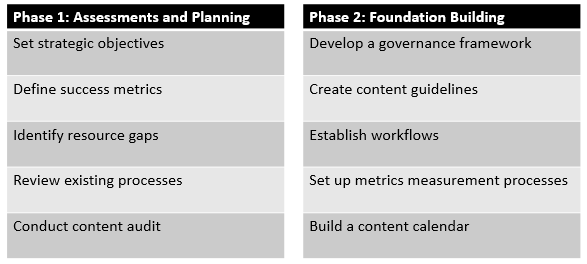
Implementing these will help improve your content strategy and content marketing successfully. After implementing the disciplines, your next crucial step is to build a team.
Team Structure and Collaboration Models
Proper planning and execution are vital to the success of any implementation. Although you may have plans and processes in place, the people are the most crucial aspect. Structuring and building teams that execute your plans and processes is essential. Below are two types of teams that will help with implementation and execution.
Core Content Team
Your core team is responsible for the day-to-day implementation and activities. They are your boots on the ground, performing all the necessary actions to make content strategy and marketing work.
- Content Strategy Director
- Content Marketing Manager
- Content Creators/Writers
- SEO Specialist
- Analytics Expert
Extended Team
An extended team supports the core team. Although they don’t perform many day-to-day activities, they help in their specific areas where necessary.
- Subject Matter Experts (SMEs)
- Designers
- Development Support
- Legal/Compliance
- Product Teams
Every organization is different regarding the number of employees, structure, and budget. You don’t necessarily need to follow this structure; however, having something similar can help.
Success Metrics and KPIs
Keeping metrics will allow you to measure the success of your integration of content strategy and marketing disciplines. In addition to measuring your success, you’ll be able to see what isn’t working, which is equally important.
Understanding what isn’t working is key to your success because you can pivot if needed, whether on the strategy or the marketing side. Below is a list of KPIs to leverage when validating successful cohesion and implementation between the two disciplines.
Strategic KPIs
Strategic KPIs help measure the success of your content strategy.
- Content quality scores
- Process efficiency metrics
- Brand consistency measures
- Governance compliance rates
- Resource utilization
Marketing KPIs
Marketing KPIs help measure the success of your content marketing.
- Engagement rates
- Conversion metrics
- Traffic growth
- Lead quality
- Revenue attribution
Conclusion
Understanding content strategy and marketing disciplines is essential for creating an online presence successfully. While your content strategy provides the foundation and framework, your content marketing performs the tactical elements that engage your audience. Successful implementation of both can create a cohesive content ecosystem that drives results and delivers value to your audience.