
Words can’t express the importance of having a content strategy framework as part of your content strategy. A content strategy framework is the backbone of your content strategy.
To improve your audience, reach and content, you should create a content strategy framework. This article breaks down what a content strategy framework is and provides actionable steps for creating one. It covers key items like setting clear objectives, measuring performance, and choosing the right platforms. This article has you covered from beginning to end.
What is a Content Strategy Framework?
A content strategy framework is a guide (roadmap) that helps teams craft, analyze, and optimize their content. The framework also helps with meeting overall business objectives.
A content strategy framework is loaded with many key areas that ensure your content thrives by giving you the tools necessary to succeed, including:
- Gaining a better understanding of your target audience
- A clear set of SMART goals
- Identifies KPIs to monitor
- Develop a list of applicable content types
- Leveraging various distributing channels, including your own website, social media, and email marketing
- Reviewing and optimizing your content to improve your rankings
Suppose you are successful in building out your framework. In that case, you’ll be able to reach your overall goal of creating meaningful content that engages your audience. You’ll also build trust and enhance your marketing success.
Treat it as a living document that evolves over time. Documenting your strategy significantly increases your chances of success.
A content strategy framework includes many elements; to better understand it, let’s focus on its key elements.
Essential Steps to Build into Your Content Strategy Framework
Successfully crafting a content strategy framework takes time, effort, and patience. You’ll need to follow the steps outlined below, as many requirements exist.
Setting Clear Goals and Objectives
The path to any successful content strategy starts with clearly defining your goals, SMART goals, to be exact. Setting SMART goals is important because they are your starting point; they must link back to your business objectives. With your business objectives and SMART goals aligned, moving forward with developing content is easier.
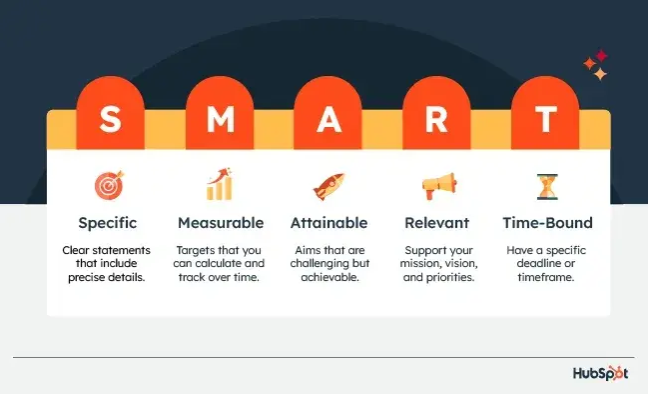
SMART goals are classified as:
- S – Specific
- M – Measurable
- A – Achievable
- R – Relevant
- T – Time-bound
You don’t want to create goals that aren’t realistic; if you do, your content won’t reach its potential because it has no purpose. Clear, measurable goals are crucial for a focused content strategy. Examples of content-related SMART goals include:
- Increase your content’s organic web traffic by 15% from Q1 2025 to Q2 2025
- Converting 10% of users/audience to customers from Q1 2025 to Q2 2025
- Develop 10 content articles for your website per month
Setting SMART goals is an absolute must; don’t proceed forward in your content development framework process without setting them.
Identifying Your Target Audience
The next important step in building your framework is identifying your target audience. Your audience is the engine behind your content. If no one reads or views it, it isn’t successful.
Once you have identified your customers, you need to understand them. Understanding them is key because your content needs to cater to their wants, needs, and pain points.
You’re probably now asking yourself, “How can you understand them?” How can you gain insights to better cater to their wants, needs, and pain points? Luckily, there are many.
Develop a Buyer Persona
A buyer persona is a crucial piece in understanding your customers. A buyer person is a documented summary of key aspects of your buyer. For example:
- Age
- Pain Points
- Challenges
- Goals
- Industry
For more buyer personal details, review the example below:

There are several ways to obtain information to build up your buyer persona, some of which are listed below.
Conducting Interviews
What better way to build a persona than to go straight to the source? Conducting interviews via email, surveys, or social media messaging will help gain customer insights. What makes interviews great is that you develop the questions; you can be as precise with your line of questions as possible.
Conducting Market Research
Market research is another great way to help craft your customer persona. It involves gathering and analyzing information about your given market. Through it, you’ll understand audience/customer characteristics and preferences. This approach will enhance your understanding of who you should focus your marketing efforts on.
Developing a Content Distribution Plan
The creation and implementation of a content distribution plan are essential. Your content relies on your content distribution plan for success. Without places to put your content, it won’t go anywhere, and no one will read or view it.
For more information on a content distribution plan, please see this in-depth article on the topic.
Choosing the Right Platforms for Your Content Distribution Plan
The first item on the list when developing a content distribution plan is choosing the right platforms. Although I recommend using multiple platforms, if you’re starting out, I recommend starting with one and being comfortable with that first before moving along. You don’t want to overextend yourself; this is especially true if you have a small team or are a solopreneur and handle everything yourself. For example, focus on your owned distribution channels first, i.e., your website’s blog or email.
When you feel ready, add content platforms, preferably 2-3. Using multiple distribution channels will help attract more eyes to your content.
Leveraging Social Media Platforms
When branching out, focus on distribution channels you don’t own, like LinkedIn, Blue Sky Social, Twitter (X), or Pinterest. These platforms have extremely large audiences; tapping into them is vital to your growth and success.
One very important thing to remember is that you must adapt your content to fit the style and expectations of each platform. For example, if you’re a B2B company, LinkedIn is the way to go. If you’re a B2C company, Blue Sky Social and Twitter(X) may be more appropriate. It also depends on your industry.
Tailoring social media posts to each platform significantly enhances audience engagement and online visibility.
Collaborating with Influencers
Another great way to expand your audience is by using platforms that belong to other people. Specifically, those that are:
- Bloggers
- Influencers
- Organizations
- Micro-influencers
You can collaborate with them by performing guest blogging. Guest blogging allows you to write blog posts on their platforms. Doing this allows you to reach a bigger audience. A bonus for you is having a backlink or multiple links to your site. Backlinks from higher domain-rated websites give your website a boost.
With this boost, you’ll have higher engagement rates over time.
Utilizing Email Marketing
With all the tools and software helping you with your content and outreach, marketers still rely most on email marketing. With the projected number of email users rising to 4.59 billion in 2025 and 4.73 billion by 2026, it’s wise for your business to capitalize on email marketing and reach as many potential customers as possible. You owe it to yourself and your business.
To use your email marketing to the fullest, create personalized emails for your audience. Having something that speaks to them improves your engagement. You should also create different types of content, such as personalized newsletters, news stories, valuable assets, and licensed news content, to engage your audience.
Develop High-Quality Content and Production Process Workflow
Developing content, more specifically high-quality content, is another key aspect that must be included in your framework. High-quality content establishes trust and credibility with your audience. Your content should educate the audience on how to remedy their pain points while offering solutions to help them.
Types of High-Quality Content to Create
Now that you understand high-quality content is a must, you’re probably asking yourself, “What type of content do I create?” Once again, you’re in luck; you can create many types of high-quality content.
Blog Post
Blog posts are the fundamental and most popular type of content developed. They come in many forms, including how-to guides, informational posts, list posts, and product comparison (versus) posts.
Videos
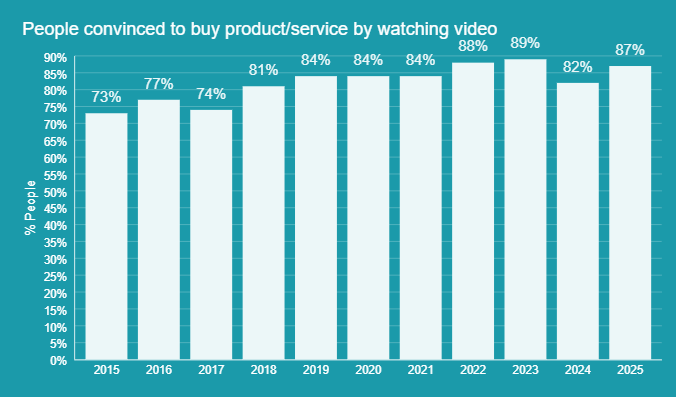
Videos are a form of content that continues to gain popularity. Many people prefer watching videos and learning more through watching videos than reading. In 2025, 87% of people were convinced to buy products and/or services by watching a video.
(Source – Wyzowl)
Long story short, creating videos is another great to cater to as many members of your audience as possible.
Infographic
Developing infographics is also great, but they are more suited to statistics, listicles, and step-by-step how-to guides. Infographics are graphical images that explain a specific topic. For example, Hubspot’s SMART goal listicle lists its acronyms and briefly defines each.
(Source – Hubspot)
Podcasts
With places like YouTube and Spotify, more and more people are using podcasts to learn more about products and how they can help them. As of 2025, there are about 4.42 million podcasts, and the number of podcast listeners is expected to reach 584.1 million in 2025. North America leads the charge with 45.20% of podcast listening, while Western Europe is second at 31.90%.

(Source – demandsage)
eBooks
eBooks are digital books that people can read online. They make great lead magnets, especially if you offer them to your audience for free or at a low price from your blog’s home page, landing page, or through email marketing.
Develop a Content Workflow Process
My favorite part of the writing process is writing. Developing a content workflow process (content management system) will improve it. When building out your workflow process, here are some key items to include:
- Research and Outline – You and your team will research content to develop. In addition, you’ll perform the content outline and gather statistics/metrics about the content’s topic.
- Writing Phase – You and your team will write your content. During this phase, you will develop the first draft.
- Quality Control – In this phase, you’ll edit content based on structure, flow, and grammar. Punctuation and fact-checking are also part of this phase.
As part of the process, you should also implement the next two items, which are crucial.
Building an Effective Content Calendar
A content calendar is an essential tool for your workflow. A content calendar helps you plan, schedule, and maintain your and your team’s writing consistency. Staying on task has to happen to be successful with content development.
Developing an Editorial Calendar
Writing is only one-half of the process. You must have a person or team to make sure your content is ready to go. In addition to an editorial team, you have to have an editorial calendar. An editorial calendar is the other side of the coin. Your content editing will follow once you’ve completed writing the first draft.
An editorial calendar ensures your content is reviewed on a schedule that lines up with your content calendar.
Measuring and Analyzing Content Performance
Establishing key performance indicators (KPIs) is crucial for measuring the effectiveness of your content strategy. Tracking KPIs helps determine whether your content meets its intended goals and resonates with the audience. Ultimately, you want to determine your content strategy’s ROI.
Conducting Regular Content Audits
Organizations that don’t track KPIs don’t improve. Without KPIs, you won’t truly understand what’s working and what isn’t. To properly analyze your KPI, you must conduct periodic content audits. Perform content audits quarterly or bi-annually to stay on top of your KPIs. If you’re a solopreneur or have a small team, try to perform an audit at least annually.
Regular content audits help identify outdated materials that require refreshing. A content audit allows you to identify gaps and outdated existing content. It also presents opportunities to repurpose existing assets.
Utilizing Google Analytics

(Source – Google Analytics)
Using Google Analytics as part of your content analysis process is a requirement. Google Analytics helps you better understand your content’s performance. This tool allows you to analyze what’s working and what isn’t. Data that Google Analytics reports include the following:
- Pages and Screen Reporting – Provides an overview of which content pages visitors engage with the most.
- Conversion Reporting – Details what content is driving conversions.
- Events Reporting – Detailed view of your visitors, system events, and errors.
Long story short, don’t ignore Google Analytics when it comes to tracking your content’s performance. This tool is a requirement if you want to analyze your content’s performance.
Summary
Creating a content strategy framework isn’t too difficult. Don’t overthink it, especially because you and your team can make changes to it over time. By implementing the strategies and tips outlined in this article, you and your team will be well on your way to creating an amazing content strategy framework.